Drs. Ann Lyerly (FACOG), Howard Brody (family medicine), and Farr Curlin (internal medicine) discuss the nuances of referral, bodily autonomy, justice, and conscience rights in an afternoon with council members including chairman Dr. Edmund Pellegrino (internal medicine).

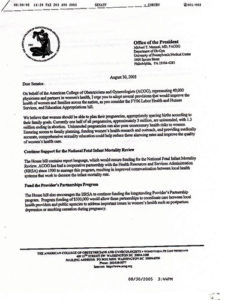
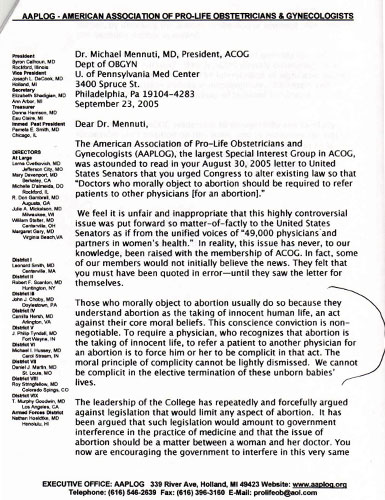 At that time, AAPLOG existed as the largest special interest group in ACOG. AAPLOG wrote to Dr. Mennuti citing that his assertion that his letter represented all ACOG membership was unsupported by a poll. Many AAPLOG members couldn’t believe Mennuti’s words erasing individual conscience rights until they saw the letter.
 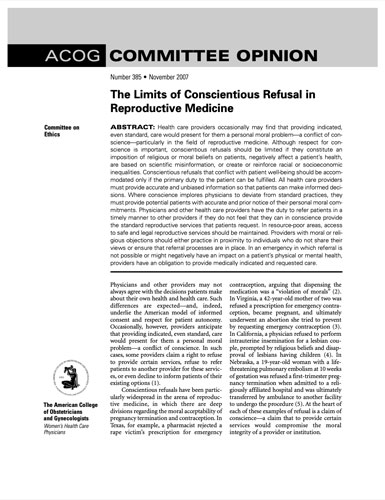 Still without consulting membership on their preferences for conscience rights or abortion referral, ACOG releases an ethics guideline that invented a duty to refer for abortion whenever a patient requests it.
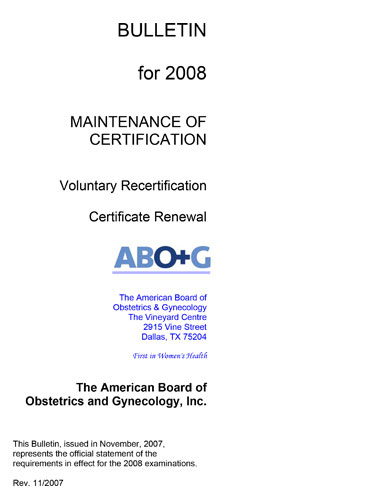 On page 31 of its bulletin on maintenance of certification, the American Board of Obstetrics and Gynecology (ABOG) added a requirement (3f) that all certified OB/GYNs comply with ACOG ethical guidelines, which would include CO 385.
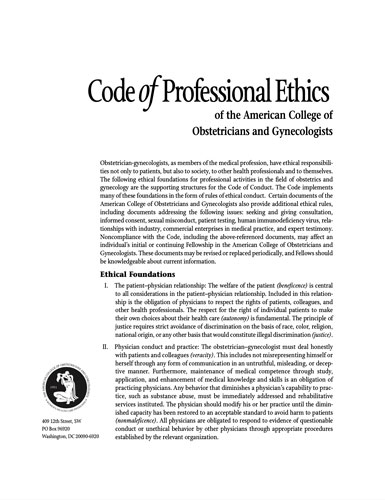 ACOG’s global ethical guidelines do not mention conscience or abortion by name but require OB/GYNs to “…refer, or cooperate with other physicians…to the extent necessary to serve the best interests of their patients.”
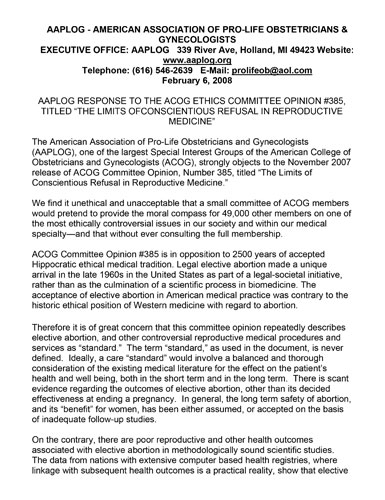 AAPLOG replies as a large special interest group within ACOG dissenting from CO 385, again demonstrating that ACOG guideline writers did not represent all members’ positions. This reply points out that CO 385 creates a new standard of care that seems to incorporate abortion as normal, although abortion arose in the profession of gynecology only in the mid-1900s after millennia of the profession avoiding it.
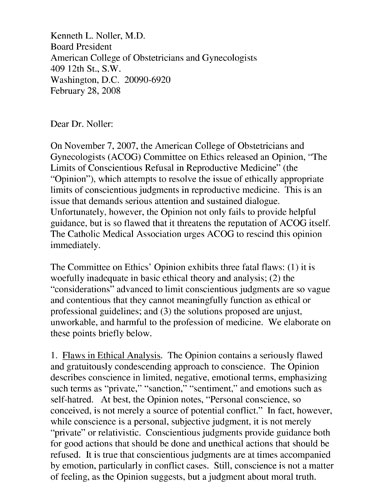 Dr. Raviele (FACOG), then president of the Catholic Medical Association, describes ethical flaws in Opinion 385 and its conflict with the American Medical Association’s Code of Ethics.
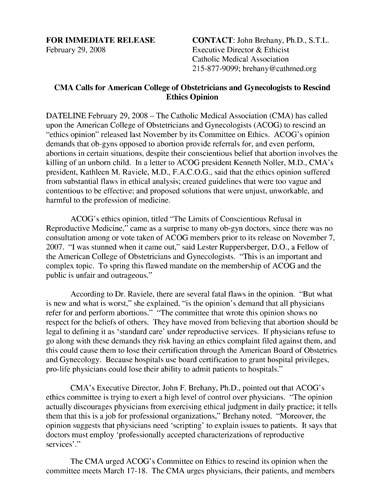 The CMA, citing Drs. Lester Ruppersberger (FACOG) and Kathleen Raviele (FACOG) cited surprise at Opinion 385’s flaws and called for ACOG’s Committee on Ethics to rescind it at their March 2008 meeting.
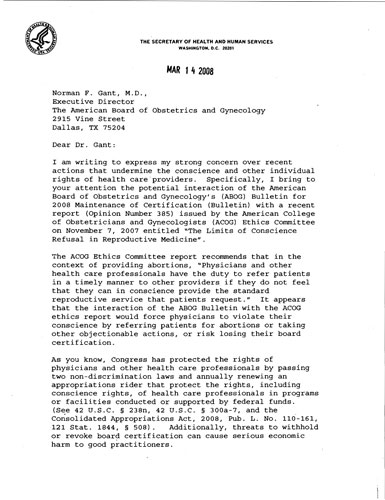 The Secretary of the U.S. Department of Health and Human Services wrote to the Executive Director of ABOG to express “strong concern over recent actions that undermine conscience and other individual rights” and requesting clarification that CO 385 was non-binding for board certification.
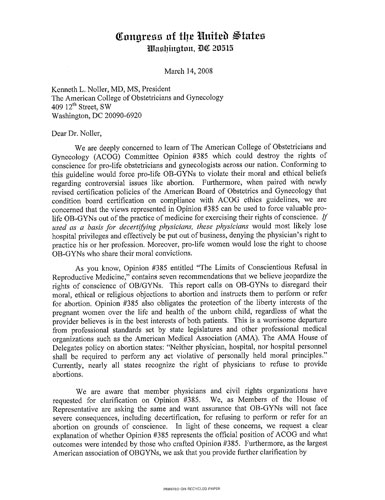 16 U.S. representatives were “deeply concerned” about CO 385 “which could destroy the rights of conscience for pro-life obstetricians and gynecologists across our nation.” They requested clarification by March 29, 2008.
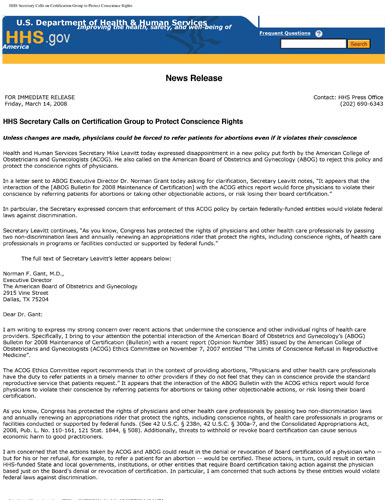 HHS released a brief explanation of events and the full text of the Secretary’s letter to ABOG.
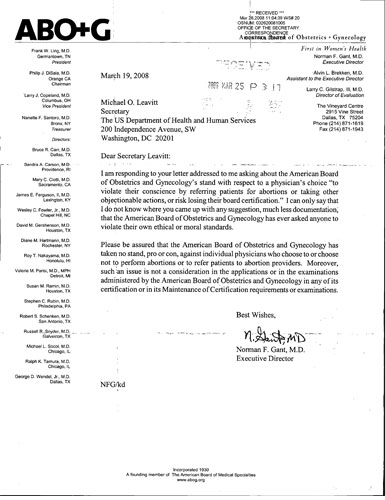 The executive director of ABOG replied to the Secretary of HHS saying “I do not know where you came up with any suggestion, much less documentation, that the American Board of Obstetrics and Gynecology has ever asked anyone to violate their own ethical and moral standards,” even though such documentation was promulgated in ABOG’s 2008 bulletin on page 31.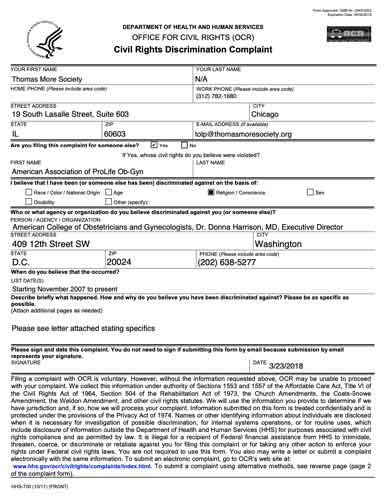
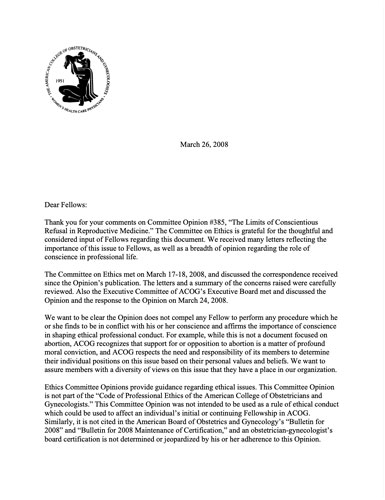 The President of ACOG wrote to reassure fellows that CO 385 does not require performance of abortion, but can not reassure that it does not require referral, because it does on page 1. He writes that the Committee on Ethics will re-evaluate CO 385. No changes are made to the Opinion.
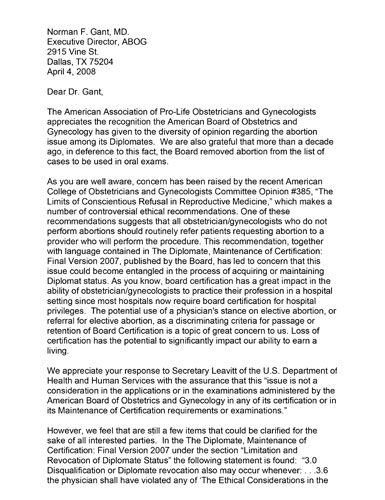 AAPLOG representatives highlight that despite Dr. Noller’s reassurance, there is another part of the 2008 Code of Ethics (page 3, section IV.2) that requires referral for patients’ best interests, and that this needs clarification to protect rights of conscience. No clarification follows.
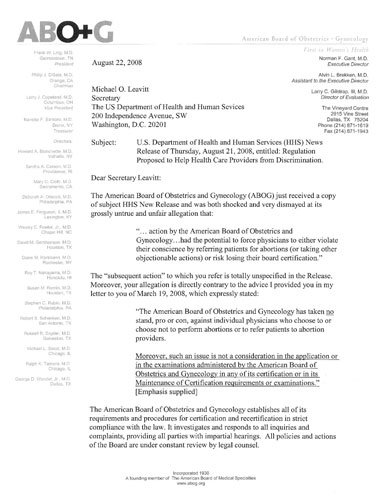 Dr. Gant turns the narrative into one about instances of individual OB/GYNs being discriminated against, and denies that this has happened. Dr. Gant does not address the language that impinges on all pro-life OB/GYNs.
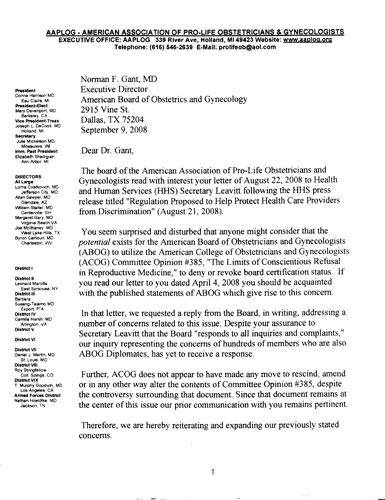 Then-president of AAPLOG writes to the Executive Director of ABOG to document the previous exchanges and demands clarification and follow-up to CO 385. It goes unanswered.
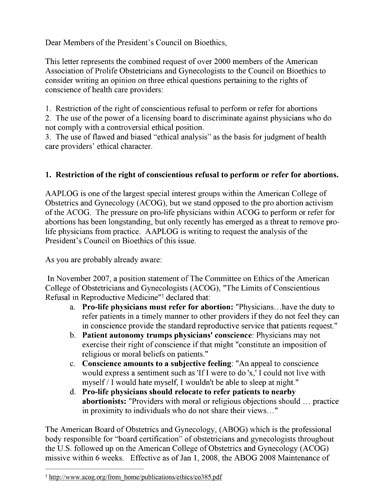 AAPLOG provided written testimony to the President’s Council on Bioethics on conscience restrictions, the misuse of ABOG’s power, and the flaws in ACOG’s ethical analysis in Opinion 385.
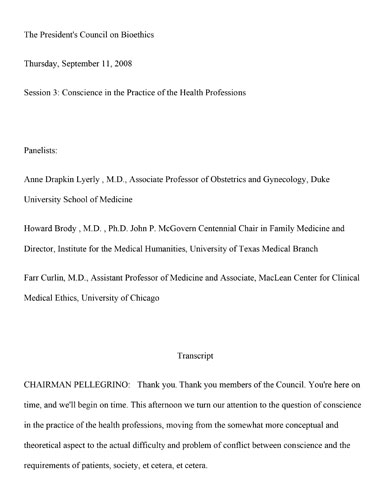 Drs. Ann Lyerly (FACOG), Howard Brody (family medicine), and Farr Curlin (internal medicine) discuss the nuances of referral, bodily autonomy, justice, and conscience rights in an afternoon with council members including chairman Dr. Edmund Pellegrino (internal medicine).
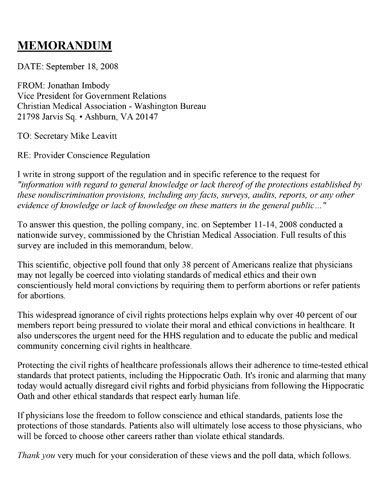 The CMA, later CMDA, reports that 40% of their membership report being pressured to violate their ethical convictions, and provides unpublished survey data from 1,000 Americans, which made clear that most Americans don’t know about doctors’ conscience rights.
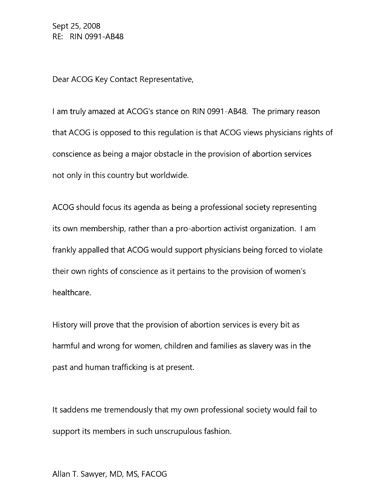 Dr. Sawyer (FACOG), who left ACOG leadership over Opinion 385 and joined the AAPLOG board, wrote to protest erasure of individual physicians’ rights to conscience during consideration of RIN 0991-AB48. He also voiced his discontent with the addition of the American Congress of Obstetricians and Gynecologists, a 501c6 able to lobby on abortion interests.
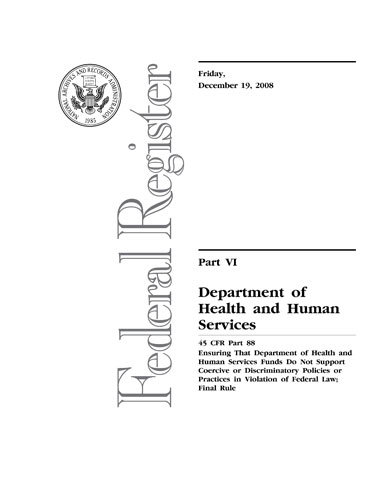 HHS issued a final rule to ensure that Department funds do not support morally coercive or discriminatory practices or policies in violation of federal law (Church Amendments, Public Health Service Act, Weldon Amendment). This includes that HHS “could not enforce…a referral requirement without violating these provisions.”
 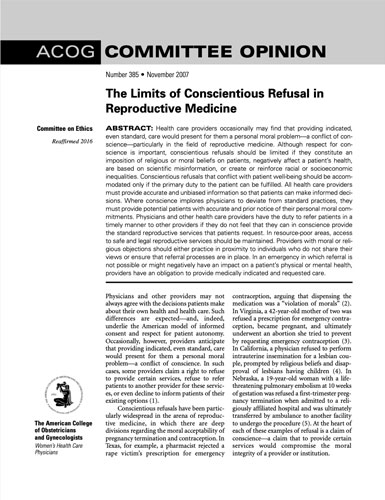 Even though ACOG members were promised in 2008 that the Ethics Committee would re-evaluate CO 385 and its limits on conscience, no changes occurred.
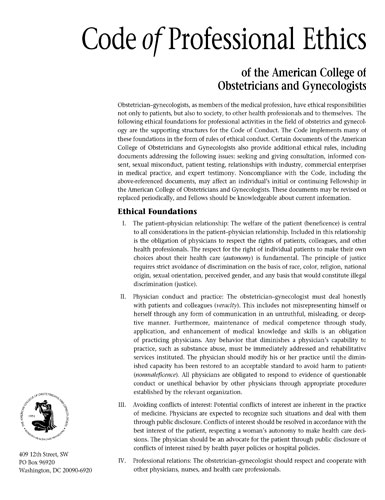 No changes to section IV.2 requiring referral for patients’ best interests is made, as was requested in 2008 to ensure that physicians still have rights to refuse referral based on their consciences.