Over the last nearly 20 years, the Accreditation Council for Graduate Medical Education (ACGME), the lone GME accrediting body in the US, has increasingly pressured OB/GYN training programs to require training in induced abortion for their residents, making many prolife medical students avoid the specialty altogether.
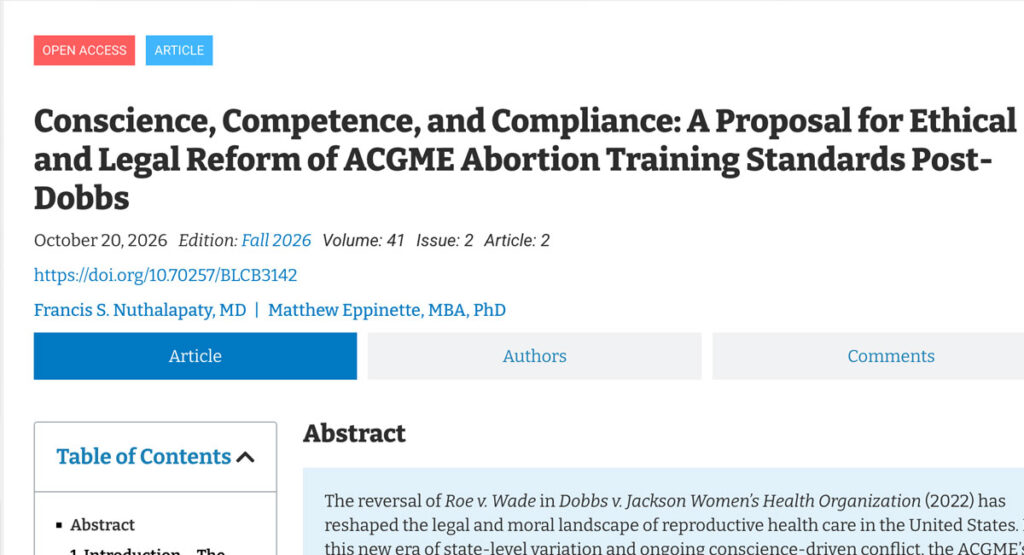
AAPLOG member and MBEC 2027 speaker Dr. Francis Nuthalapaty co-authored a peer-reviewed paper for the Journal of the Alliance for Hippocratic Medicine (ILM-JAHM) titled “Conscience, Competence, and Compliance: A Proposal for Ethical and Legal Reform of ACGME Abortion Training Standards Post-Dobbs.”
The article notes the moral and legal tension in the ACGME’s abortion training standards. Nuthalapaty also notes that in 1996, the ACGME required all OB/GYN programs to make induced abortion training available while allowing moral and religious exemptions. In 2018, the ACGME began requiring induced abortion training in OB/GYN residency programs, shifting from opt-in to opt-out and automatically enrolling residents unless they object, which puts residents in a vulnerable position career-wise.
Since 2022, more than half of United States have laws that restrict or prohibit induced abortions. Yet these abortion training requirements remain in place through the ACGME standards, and a resident who refuses to comply could put his or her professional future at serious risk.
He explores ACGME’s role and influence and the conflicts in its current legal and bioethical standards.
Dr. Nuthalapaty analyzes how the ACGME standards can be ethically analyzed to reform the abortion training requirements. He looks at four-tiered reforms:
- At the federal level, the separation of GME funding from abortion training ensures compliance with federal appropriations law and public accountability.
- At the state level, a model of state-consistent compliance respects federalism while maintaining educational equivalence through alternative training pathways.
- At the institutional level, conscience-based exemptions safeguard the participation of faith-based hospitals in medical education without diluting academic rigor.
- At the individual level, an opt-in framework for abortion training affirms the autonomy and moral agency of each trainee, fostering authentic professional formation.
By addressing the federal, state, institutional and individual levels, Dr. Nuthalapaty concludes that this approach would ease tension between moral and legal obligations while aligning with the “values of a diverse society and the principles of professional freedom.”
We encourage all members to read the full paper here and consider sharing with colleagues and becoming involved with AAPLOG Action’s efforts to support conscience rights of medical trainees at a state and federal level.